

18 hr
Paracas, Huacachina & Pisco Vineyard Full-Day Escape
Desert oasis, wildlife islands, and Peru's iconic spirit—all in one epic coastal adventure from Lima.
Reserve

Hand-picked by our editors — only the best 5 full-day adventures from 22 operators reviewed.
Verified partners for every tour, free cancellation where available, and instant confirmation on every booking.
18 hr
Desert oasis, wildlife islands, and Peru's iconic spirit—all in one epic coastal adventure from Lima.
Reserve
24 hr
Explore coastal wildlife, ride giant sand dunes, and toast the sunset in Peru's only natural desert oasis
Reserve
17 hr 30 min
Journey from coast to desert: encounter wildlife at Ballestas Islands, taste regional wines, and ride dunes at an iconic oasis
ReservePrices from verified partners. Availability updates in real time at checkout. Free cancellation policies apply where shown.
The landmarks, rooms, and views travelers on this tour remember — all visible on a single visit.
A natural desert lake fed by an underground aquifer, covering roughly three hectares of land. It is the only natural oasis in South America, traditionally famed for its mineral-rich waters.
A bronze sculpture depicting the weeping princess from the local Incan legend. Positioned on the malecón, it marks the exact spot where the mythological maiden is said to have dove into the waters.
A paved walkway that completely circles the lagoon, lined with old carob and eucalyptus trees. It was constructed in the early 20th century when the oasis became a fashionable resort for wealthy Peruvians.
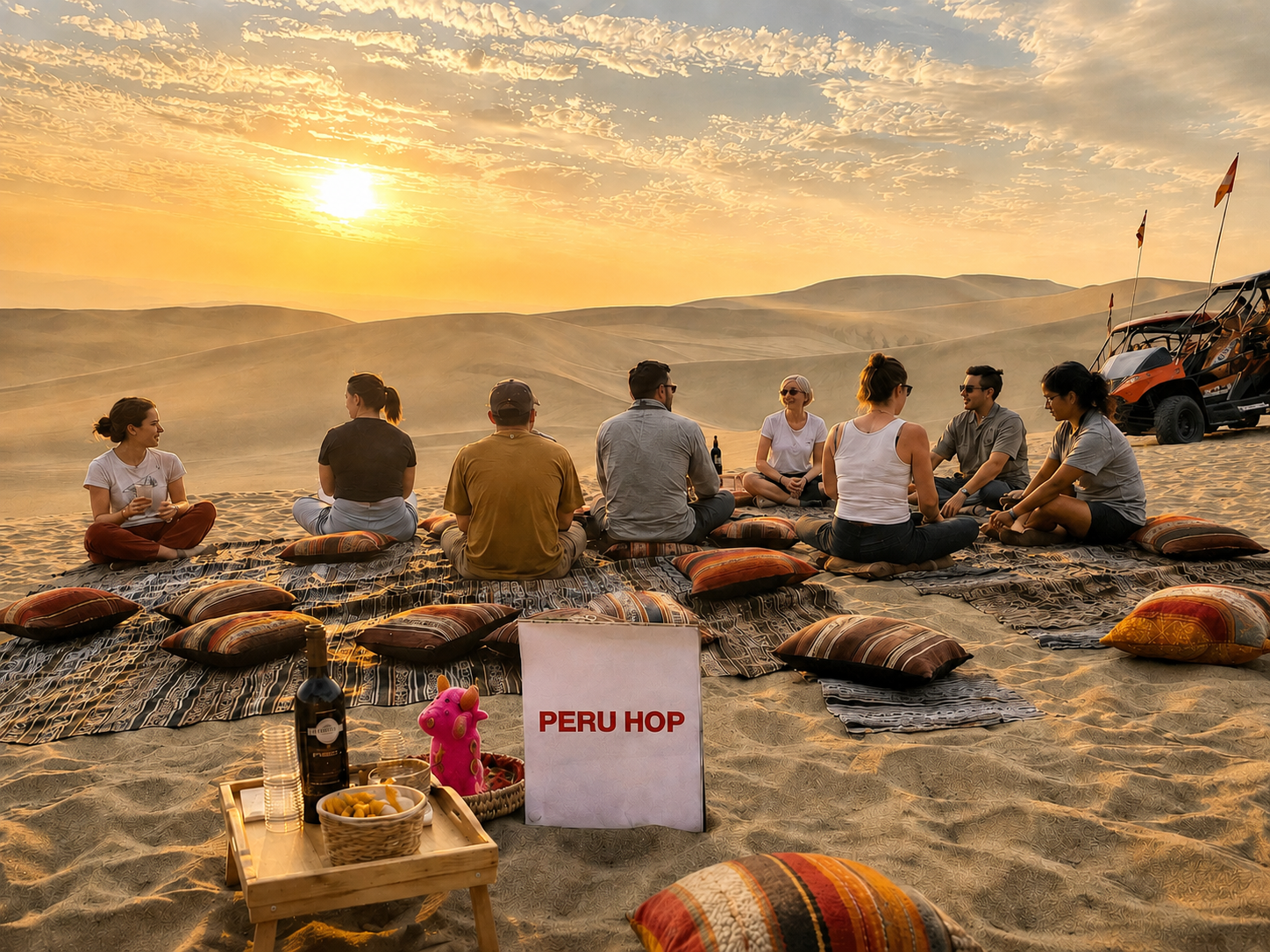
Massive sand formations that rise over 100 meters above the valley floor. Visitors climb to these peaks in the late afternoon to watch the sun sink below the horizon, painting the desert in orange hues.
The designated departure point at the base of the northern ridge where custom 4x4 dune buggies gather. Up to 50 colorful buggies can be seen preparing for their high-speed desert excursions daily.
Choosing between different lima to huacachina day tour tours depends on whether you seek a Huacachina oasis excursion or coastal wildlife. Both destinations showcase the unique geological diversity of southern Peru, making them excellent choices for day trips from the capital.
| Feature | Top pick Huacachina Tour | Paracas Reserve Tour |
|---|---|---|
Primary focus |
Adventure activities and oasis recreation | Marine wildlife viewing and coastal hikes |
Landscape type |
Desert sand dunes and natural lagoon | Coastal cliffs, beaches, and ocean waters |
Main activity |
Sandboarding and riding dune buggies | Boat touring and observing marine life |
Travel time from Lima |
4.5 to 5 hours each way | 3.5 to 4 hours each way |
Best for travelers who enjoy |
High-speed action and desert sunset views | Wildlife watching and peaceful marine landscapes |
| See tickets → |
Verdict: Ultimately, choosing a lima to huacachina day tour tour is the best option for active travelers who want to experience sandboarding on the dunes. The high-speed buggy rides provide a thrill that coastal tours cannot match. For those interested in marine wildlife, the Paracas coastal cliffs offer a completely different ecosystem. Securing your lima to huacachina day tour tickets with a combined itinerary provides the best of both worlds, letting you experience both landscapes in a single day.
Choose your ticket, select your date, and reserve in under two minutes. Secure checkout handled by our verified partner.
Instant confirmation by email, with a mobile voucher you can save offline. No printing, no queuing at a collection desk.
Arrive at the entrance, show your voucher on your phone, and walk in. Most tickets include priority or skip-the-line access.
Practical details for your visit straight from our verified partners — hours, access, rules, and how to get there.
Av. José Larco 799, Miraflores, Lima
Buses collect passengers directly from major hotels in Miraflores and San Isidro.
Drive south from Lima via the Pan-American Highway (Route 1S) directly to Ica, then follow the signs to the oasis. The route is paved and features multiple toll booths along the coastal desert.
Take a long-distance bus from Lima to Ica, then hire a local taxi to reach the lagoon. Several reputable bus companies operate direct daily routes from Lima to the Ica terminal.
Private taxis can be chartered from Lima to the oasis for direct transfer. Ensure you agree on a fixed rate with a registered driver before departing.
Lightweight, breathable clothing is recommended for the desert heat, along with a windbreaker for the evening dune buggy rides. Closed-toe shoes, such as sneakers, are essential for sandboarding to prevent hot sand from burning your feet.
Only small daypacks are allowed on the dune buggies; large suitcases must remain in the transport vehicle. Security checks are not conducted, but you should secure all loose belongings before entering the dunes.
Standard cameras and smartphones are allowed without fees, though protective sleeves are recommended due to fine blowing sand. Drone use over the lagoon and protected dune areas requires a permit from local authorities.
The sandy terrain surrounding the oasis is not wheelchair accessible, making dune buggy tours unsuitable for visitors with mobility impairments. The flat paved promenade (malecón) provides limited accessibility near the water.
Mobile signal is generally reliable near the oasis but drops off behind the high dunes. Protect your device in a sealed plastic bag to prevent fine sand from entering the ports.
Children under the age of seven are generally not permitted on high-speed dune buggy rides for safety reasons. Families can rent pedal boats on the lagoon or walk the gentle slopes at the base of the dunes.
A variety of restaurants line the malecón, offering Peruvian food and beverages. Bringing bottled water to stay hydrated in the desert heat is highly encouraged.
Pets are allowed on leash around the lagoon promenade but are strictly prohibited on the dune buggies and within the protected dune reserve.
Most operators of a Lima to Huacachina day tour tour handle the municipal sand tax, but it is wise to carry small change. Always verify the safety credentials of the vehicle before boarding.
Av. José Larco 799, Miraflores, Lima
Buses collect passengers directly from major hotels in Miraflores and San Isidro.
Get directionsOasis de Huacachina, Ica 11000, Peru
The main drop-off and pickup point for returning vehicles is near the entrance boulevard.
Get directionsBest time to go, insider tips, nearby landmarks, and the cancellation fine print — flip through to skim what matters to you.
How crowds, weather, and events shift across the year.
Expect hot temperatures averaging 30 degrees Celsius and intense sunshine. This is the busiest tourist season, making early booking of buggy tours essential. Clear skies provide excellent conditions for watching the sunset over the desert.
Temperatures gradually cool down to a pleasant 25 degrees Celsius. Crowds begin to thin out after the Easter holidays, making it an ideal time for a relaxed trip. The winds are generally calm, offering excellent sandboarding conditions.
Days remain sunny with averages of 22 degrees Celsius, but evenings can be chilly, dropping to 12 degrees Celsius. Afternoon winds can kick up dust storms, so goggles are recommended for dune activities. This is a popular travel season for international visitors.
Mild weather dominates, with temperatures hovering around 24 degrees Celsius. Crowd levels are lower compared to summer, providing a quieter experience around the lagoon. The late afternoon light is perfect for desert landscape photography.
Small details that turn a good visit into a great one.
Book your Lima to Huacachina day tour in advance to secure a seat on the afternoon dune buggy rides. The late afternoon slots are highly sought after for the sunset views.
Carry physical Peruvian Soles cash to pay the municipal ecological dune tax. Most street vendors and small stands near the lagoon do not accept credit cards.
The desert wind blows fine sand that can easily ruin camera lenses and charging ports. Keep your electronics in sealed zip bags when not actively taking photos.
Avoid wearing sandals or flip-flops during sandboarding. The desert sand absorbs heat rapidly and can cause minor burns to exposed feet.
The high UV index in the desert requires regular application of sunscreen. A wide-brimmed hat and sunglasses are also essential to protect against the glare.
Bring at least one liter of drinking water per person for the afternoon dune activities. Dehydration can set in quickly due to the dry air and physical exertion.
Non-bookable sights within a short walk — free to visit, easy to pair.
The natural lagoon at the center of the oasis is framed by palm trees and eucalyptus groves. Visitors can walk the perimeter to view the scenic landscape and rent pedal boats.
A bronze sculpture located on the promenade commemorating the Incan legend of the weeping princess. According to myth, her tears created the lagoon and she still swims in its waters.
The central plaza of the neighboring city, featuring colonial architecture and manicured gardens. It is a historical gathering point for locals and visitors alike.
A prominent neoclassical church in Ica dedicated to the patron saint of the city. The structure was rebuilt after a major earthquake and serves as a key spiritual site.
A historic vineyard offering insights into traditional pisco production methods using clay jars. Visitors can tour the aging cellars and learn about the regional distillation history.
Flexible, no hidden fees.
For guests booking a Lima to Huacachina day tour, cancellations made at least 24 hours prior to the scheduled departure receive a full refund. The 0 PEN entrance fee to the oasis is non-refundable if ecological tax has already been processed for dune access.
Hand-picked options within walking distance — pick a district for vibe, or a specific hotel for convenience.
A historic hotel featuring colonial architecture and a central courtyard. It sits right on the edge of the lagoon, offering direct access to the promenade.
An accommodation featuring an outdoor pool and views of the sand dunes. It is located just a short walk from the main buggy launching points.
A popular hostel known for its pool, gardens, and on-site dining options. It is a frequent base for travelers joining desert buggy tours.
Huacachina emerged in the 1940s as a curative retreat for Lima's tuberculosis patients, drawn to the iron-rich waters of a single palm-fringed spring fed by the Ica aquifer. The lagoon sits four metres below sea level, cradled by dunes that rise to 120 metres and advance three to five metres annually under prevailing westerly winds. By the 1960s the sanatorium had closed, the water table had begun its slow retreat, and the village pivoted to leisure tourism. Today the oasis remains the only naturally occurring desert lagoon in South America, sustained by seasonal pumping and a 1998 municipal conservation ordinance. The journey from Lima traces the spine of Peru's coastal desert, crossing the Panamericana Sur through the Cañete river delta and the Chincha cotton belt before reaching Paracas at kilometre 245. Here the Humboldt Current collides with upwelling thermoclines, nourishing the Ballestas Islands' colonies of Peruvian boobies, Humboldt penguins, and South American sea lions. The rocky archipelago shelters an estimated 180,000 seabirds across 11 resident species, their guano deposits harvested under strict quotas since colonial extraction nearly collapsed the ecosystem in the 19th century. Eastward, the Paracas National Reserve protects 335,000 hectares of coastal desert and marine shelf, inscribed as a UNESCO Biosphere Reserve in 2011. Ica's wine and pisco tradition dates to 1563, when Spanish settlers planted the first Quebranta and Italia vines in alluvial soils fed by the Ica River. The region now produces 87 percent of Peru's pisco, distilled from eight approved grape varieties in copper pot stills and aged in resting tanks rather than oak. Artisanal bodegas around the city offer tastings of acholado blends and single-varietal piscos, many still employing colonial-era stone pressing troughs and clay tinajas for fermentation. The appellation was codified in Peruvian law in 1991, reserving the term pisco exclusively for spirits distilled within five coastal departments. Huacachina's dune field belongs to the Ica Sand Sea, a 2,000-square-kilometre erg formed by wind-sorted particles eroded from the Andes and transported westward over three million years. The sand is quartzite-rich, angular in grain structure, and reaches surface temperatures of 65°C during summer midday. Sandboarding and dune-buggy circuits were introduced in the late 1990s, regulated since 2008 by municipal permits that restrict vehicle access to designated corridors to prevent dune-face erosion. The village itself comprises fewer than 100 permanent residents, its economy sustained entirely by the 200,000 annual visitors who arrive between May and September, when coastal fog clears and afternoon winds stabilize the sand.
"The only naturally occurring desert lagoon in South America, sustained by seasonal pumping and a 1998 municipal conservation ordinance."
A step-by-step walkthrough of the visit — what you'll see, how long each stage takes, and the details that matter.
You depart Lima before dawn, the Panamericana Sur threading south through the grey coastal mist known locally as garúa. By kilometre 245 the fog lifts and Paracas appears, a low terracotta port beneath rust-coloured cliffs. You board a motorboat at the municipal pier, the hull cutting through cold morning swells toward the Ballestas Islands. Cormorants and boobies wheel overhead, their cries sharp above the diesel hum, while sea lions bask on guano-stained ledges. The circuit lasts 90 minutes, close enough to the rocks to catch the acrid salt-and-ammonia scent of the colonies. Back on land, the coach turns inland toward Ica, crossing irrigated cotton fields that give way to bare pampa. At a family-run bodega you taste three piscos — a floral Italia, a vegetal Quebranta, a blended acholado — poured straight into tulip glasses, no ice. The distiller explains the eight-month fermentation cycle and points to clay tinajas half-buried in the courtyard. You continue south, the road narrowing as the dunes rise. Huacachina announces itself suddenly: a crescent of palms, a jade-green lagoon, and the yellow dune wall climbing behind the village. You transfer to an open buggy at 4 p.m., the driver accelerating up the steepest face in second gear. The engine roars, sand sprays, and the oasis shrinks below. At the summit you strap a waxed board to your feet and carve a long diagonal descent, the sand hissing beneath the base. The sun drops toward the Pacific, backlighting the palms in amber, and you return to the lagoon as the first lights flicker on along the boardwalk.
The dry, sunny climate of the Ica desert makes a visit viable year-round, though the best months are from December to April. During these months, temperature conditions in Huacachina are ideal for sandboarding.
Dress in light, breathable clothes for the afternoon heat, but bring a windbreaker for the evening breeze. Closed-toe shoes are essential to safely traverse the sand dunes of Huacachina.
Yes, a professional Huacachina dune buggy tour is usually the main highlight of the trip. Most packages combine this ride with sandboarding down the massive desert dunes.
Yes, older children can participate, but the high-speed dune buggy rides may not be suitable for kids under seven. Families visiting Huacachina can opt for slower activities like pedal boats on the central lagoon.
Most operators offer a full refund if you cancel at least 24 hours prior to departure. The municipal dune tax for entering the Huacachina Reserve is typically non-refundable once issued.
The drive takes approximately 4.5 to 5 hours each way along the Pan-American Highway. Most day trips split up the travel time with a stop in Paracas before arriving at Huacachina.
Some premium tours include lunch at a traditional vineyard in Ica, while others provide free time to dine. You will find plenty of local restaurants around the promenade in Huacachina to enjoy a meal.
Yes, it is highly recommended to carry cash in Peruvian Soles. The local municipal tax for accessing the protected dunes of Huacachina must be paid in cash at the gate if it is not pre-included in your tour price.
Yes, many itineraries combine a morning boat cruise to see wildlife in Paracas with an afternoon visit to the dunes. This allows you to experience both coastal marine life and the desert oasis in a single day.
You will see the Ballestas Islands, traditional pisco vineyards, and the historic dunes surrounding the lagoon. The primary destination remains the natural oasis located in the Ica region.